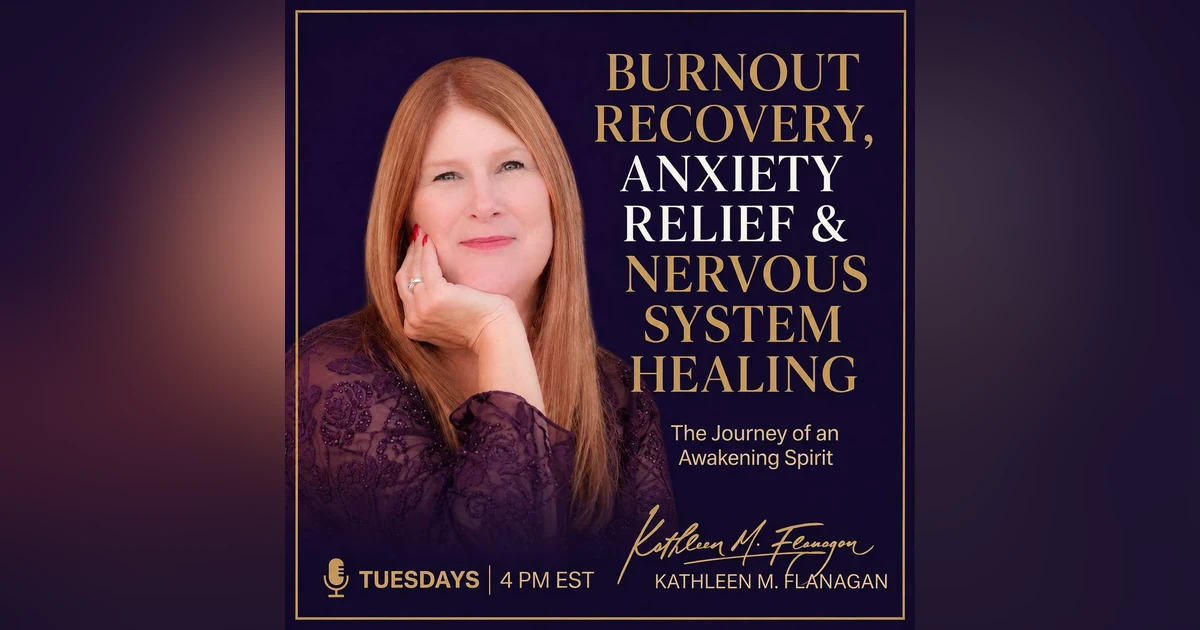
Why Saying No Feels Like Danger (It's Not Weakness)
Why does setting a boundary feel physically unsafe, even when I know I'm right? Saying no can feel like stepping off a cliff, and that's not weakness. Kathleen explains people-pleasing as a survival strategy your body learned, and why “just set a boundary” fails when your nervous system treats disapproval as danger. In this episode: where the people-pleasing response comes from, why the discomfort of a boundary is physical, and one thing to notice this week before you try to change anything. Next step: Head Heart Switch, a 4-minute video for $9 — https://ds.kathleenmflanagan.com/switch. Free webinar coming soon: She's Tired of Being Strong


Have you ever said yes when every part of you wanted to say no? You know you're already overwhelmed, exhausted, and stretched too thin, but the thought of disappointing someone feels even worse than taking on another responsibility.
What if your struggle with boundaries isn't a lack of confidence or willpower? What if your nervous system learned long ago that keeping everyone else happy was the safest way to survive?
In this episode, Kathleen M. Flanagan explores the hidden connection between people-pleasing, emotional safety, and the nervous system. Discover why saying no can trigger guilt, anxiety, and fear, even when you know setting boundaries is the right thing for you.
In This Episode, You'll Discover:
-
Why saying no can feel emotionally and physically threatening.
-
How childhood experiences and past relationships can shape people-pleasing patterns.
-
Why your nervous system may associate disapproval with danger.
-
The difference between healthy generosity and saying yes out of fear.
-
Why forcing yourself to set boundaries doesn't always resolve the underlying anxiety.
-
How to recognize the physical signs of an automatic survival response.
-
A gentle awareness practice to begin rebuilding self-trust and emotional safety.
The Deeper Truth
You weren't necessarily born believing everyone else's needs mattered more than yours. Somewhere along the way, you may have learned that being agreeable helped you maintain peace, approval, or belonging.
But a strategy that once helped you feel safe may now be keeping you exhausted, disconnected, and resentful.
Healing isn't about becoming harder, colder, or less compassionate. It's about discovering that you can care deeply about others without abandoning yourself.
Your Practice This Week
Notice one moment when you want to say no but feel compelled to say yes. Pause and observe what happens in your body. Notice the tightness, the hesitation, or the fear of disappointing someone.
You don't have to force yourself to respond differently. Begin by noticing without judgment.
Awareness is the first step toward creating a new relationship with boundaries.
Resources Mentioned
💜 Head Heart Switch — $9: A four-minute video to help you move from mental overwhelm toward greater inner awareness.
💜 She's Tired of Being Strong: Learn more about Kathleen's upcoming free webinar exploring the hidden emotional exhaustion experienced by strong, capable women.
💜 I AM the Light Sanctuary: Join a supportive community of women learning to reconnect with themselves, develop emotional safety, and live with greater peace and alignment.
Connect With Kathleen
Website: https://kathleenmflanagan.com
Community: https://www.skool.com/iamthelightsanctuary/about
YouTube: @kathleenmflanagan
Remember: Your body isn't broken. It's doing what it learned to do. You deserve to feel safe honoring your own needs, and you don't have to earn love by saying yes to everything.
Subscribe to The Journey of an Awakening Spirit for weekly conversations about burnout recovery, nervous system healing, emotional freedom, and reconnecting with your authentic self.
skool.com/iamthelightsanctuary/about
www.kathleenmflanagan.com
www.youtube.com/@KathleenMFlanagan
Dancing Souls Book One - The Call
Dancing Souls Book Two - The Dark Night of the Soul
Dancing Souls Book Three - Awakened
www.awakeningspirit.com
www.grandmasnaturalremedies.net
De-Stress Meditation
kmf@kathleenmflanagan.com
00:00 - Why Saying No Feels Like Danger (It's Not Weakness)
02:16 - Why Do I Always Say Yes When I Want to Say No?
05:16 - People-Pleasing and the Fear of Disappointing Others
08:16 - How Childhood Experiences Shape People-Pleasing Behaviors
11:16 - Why Your Nervous System Treats Boundaries Like Danger
14:16 - Physical Signs of Anxiety When Setting Boundaries
17:16 - Why Setting Boundaries Feels So Hard
20:16 - How to Stop People-Pleasing Without Feeling Guilty
23:46 - A Simple Nervous System Exercise for Setting Boundaries
27:46 - How to Build Self-Trust and Feel Safe Saying No
0:02
You know the moment someone asks you something, your time, your energy,
0:10
a favor, and before your mind has even finished weighing it, your your mouth has already said
0:17
yes. And then almost immediately that tight sinking feeling, why did I just do that again?
0:26
If that's familiar, I want you to know something before we go any further. That is not a character
0:33
flaw. That is your nervous system doing exactly what it was trained to do. Today, we're going to
0:40
look at why. Welcome back to the show. Last week, we talked about why real rest can feel dangerous.
0:49
This week, we're going one layer deeper into why the boundary itself, the actual word no, can feel like stepping off a cliff.
1:02
So, what I'd like to do is talk about when something like that happened to me. And it
1:08
was actually when my husband ex-husband proposed to me. He um we were going for custody of his
1:17
daughter. I think was around that time and I just couldn't say yes at that moment. I I
1:25
had a lot of reservations. I was in a high stress situation because we were driving back and forth
1:31
to Kansas to establish a relationship so we could bring her back to Colorado. And I just couldn't
1:40
quite get around it. I so I just didn't answer the question. And then as we proceeded doing
1:50
all of this with his child, there came a point where she was living with us and it was strongly
2:00
suggested that we get married to establish, you know, a safe, secure, solid foundation home.
2:10
So, we decided to do that and I said, "Okay." I was okay with that. At the time, I was a nervous
2:15
wreck. I wanted her to feel welcomed and involved in everything. So, she was a bridesmaid and she
2:23
went dress shopping with me and she helped me with all of this because I really wanted to
2:28
make this work. what ended up happening after a while because his in-laws, ex-in-laws were just
2:40
a real piece of work and they made me crazy and they were and I know they were trying to get him
2:47
put into jail for sexual abuse and all this and that was the last thing he would have ever done
2:51
to his child. and we we got married and I think it was within a year after we got married I couldn't
3:03
take it anymore between what the family was doing, what we were doing, how important it was and I
3:10
couldn't cope because I was 14 once and I know what 14-year-old girls are like and we're little
3:16
demons and she was very demonic on so many levels towards me and I even though I could understand
3:22
it. I was already in a fight or flight trying to defend myself, trying to be a good person,
3:31
trying to be the people pleaser because I felt like I was a failure. So I remember my husband
3:49
doing, you know, just trying to be himself and trying to navigate how to deal with me,
3:55
his new bride and his daughter. And so the house was very stressful at that point. And
4:00
I just remember that I wasn't about to make him make a decision. And so I remember I was like a wounded animal in the corner of the kitchen just crying hysterically if I can't do this anymore. I
4:10
just can't. I just can't. And I'm going to get I'm asking for a divorce so you can have your
4:16
daughter cuz I would never make him choose. That was how bad it was. And he got on the phone with
4:23
the lawyer and just basically said, "No, we're done. Take her back. We're taking her back."
4:28
But we had conditions, but that didn't matter because that family just came in and and just did whatever they wanted to do and nobody ever stopped them. So that was the main thing that
4:39
went on with that whole situation. And I remember just feeling guilty and a failure and all of that
4:46
and not even understanding on on the backside of what was really going on during that period
4:52
of time. But I I know that the day after I got married, I realized that I had made the the wrong decision. I knew that. I knew that it wasn't going to work. I knew there was so many
5:02
things wrong. And it wasn't necessarily with us as much as it was with me. So,
5:12
we stayed married for about five and a half years before we got divorced. And I was always doing
5:20
what I could because he had a very violent temper. And I just remember always whatever he needed to
5:26
just keep him calm and keep him from that temper flaring. So, you know, there was a lot of times
5:32
that I just became so much of a people pleaser towards him to keep the peace because I couldn't
5:38
handle violence. I couldn't handle anger. I couldn't handle his rage. I couldn't handle
5:44
his jealousy, his controlling nature. I couldn't handle any of it. So, what did I do? I started
5:51
shrinking because a lot of times that's what we do as people pleasers that we will sacrifice
5:57
ourselves to just not be tortured and to maintain peace in the house. And and I didn't know so much
6:11
back then. I didn't know I was in a survival mode. I didn't know I was dealing with trauma.
6:16
I didn't know any of that. And that's sometimes the beauty of life is that we don't always know,
6:22
but we always wonder why am I doing this? Why am I saying yes when I really want to say no? And I
6:29
never stopped to look at what that was because I couldn't find it. That was the main thing is
6:36
sometimes we just can't find why we do the things that we do. We're just seem to be like the devil
6:44
took over, so to speak, that we're doing things out of habit and we're not doing anything because
6:50
it's what we want. It's how we feel. It's where we want to go. So, we work on autopilot. And I
6:58
remember for years I used to say, "How do I know what I don't know? How do I find what I what I'm
7:04
thinking that I'm not unaware I'm unaware of in the subconscious unconscious part of the mind? Because in order to change that, we have to face it. Well, I didn't realize back
7:14
then that this was a nervous system response action. And the only reason I know that today
7:20
is because after my father passed away, my nervous system shut down and I was forced to
7:26
look at this. And so when I did that and I started establishing boundaries when I lived in Chicago,
7:35
that was when the beginning of me starting to heal the nervous system. not fully,
7:41
but they were beginning signs of moving into that next place of healing because I because
7:49
a lot of times to just get people to stop yelling, I would do whatever they wanted.
7:53
And that was when I started to put my foot down to say no. And I needed I needed to
8:07
just face everything and deal with it and just find my value and my worth because a lot of times
8:15
we don't think that we are worthy and valuable and that we should just be a doormat for somebody. and
8:23
that wasn't serving me and it doesn't serve anyone and it doesn't add to healing what we
8:29
feel. So when we call this people pleasing and we talk about it like it's a personality trait like
8:36
some people are just givers and some aren't. And I want to push back on that today. This
8:42
isn't who you are. It's a trained response and it lives in your body and it's not your character.
8:51
So, let's talk about where that training came from. At some point, maybe many points over many
8:59
years, saying no cost you something real. Maybe it cost you someone's approval. Maybe it cost you
9:09
the peace in a room. Maybe it cost you a sense of belonging you couldn't afford to lose. and
9:17
your nervous system doing exactly what nervous systems are built to do. Found the fastest,
9:24
most reliable way to keep you safe, keep everyone else comfortable, even it cost you something
9:31
internally. That's not weakness. That's a survival strategy that worked at least well enough,
9:40
often enough that your body kept using it. So, here's the part I really want to land today. Your
9:48
body doesn't file this under social awkwardness. It files it under danger. When you go to say no,
9:55
your body runs the same threat response it would run if something in your environment were actually
10:02
unsafe. Tight chest, racing thoughts, the urge to backpedal. That's not you being dramatic. That's a
10:12
very old alarm system. treating disapproval like it's the same thing as danger because for a long
10:18
10 , 18
time in your history it functionally was. So I want to bring this home a little bit more of an
10:27
observation of a friend, a so-called friend that when I moved to Chicago, she offered me to stay
10:35
in her home. And when I arrived in Chicago, she informed me that I wasn't staying with her. And
10:45
I was completely taken off guard. And I said, "Okay, well then just tell me where a hotel is and I'll just go stay at a hotel for the evening or for for the next couple of days cuz I knew I
10:56
would find something fairly quickly. So, I wasn't worried about that. It was just I needed a place to land because I just drove like a thousand miles from Colorado. I had like my clothes and my cats
11:06
11 , 6
and that was all I had. And she was like, "No, no, no. I'm not going to have you do that." I said,
11:12
11 , 12
"It's not a problem." And I asked her why this was going on. And she eventually told me later on that
11:20
she offered her home to somebody once before and they never moved out. And I said, "Well, that's not going to be me." Because I didn't want to live with her any more than she wanted to live
11:29
11 , 29
with me. So that wasn't going to be the problem. So what she had done in her own peopleleasing way,
11:37
she had turned around and asked a friend of hers to put me up. Now, he didn't want to do this any
11:44
11 , 44
more than I wanted to go there, but she was very insistent, very persuasive. And and the reason
11:51
I think she was so pers persuasive on this was because she wanted to make sure that she was okay,
12:00
12
that we liked her, that she did a good thing, and she could put her nervous system that was
12:04
12 , 4
on overactive, and she said yes when she wanted to say no, and she found a way to back out of it.
12:13
12 , 13
So he sends up. So I end up going to his place and it was very apparent I wasn't welcome. I didn't
12:21
want to be there. He locked the basement door so I couldn't go upstairs. Not that I was ever going to go upstairs. I had it was a walkout basement so I was able to go into the basement and I was only
12:31
there a couple of nights because I was working I found an apartment and I was working on getting it
12:37
kind of updated, painted, things like that. And I would be come home like at 9 10:00 at night and I
12:45
would be out of the house by 7:00. The only thing I did with there was sleep and take a shower. And
12:51
one day I came home and it was like 9 10:00 at night and the basement is flooded. And I I
12:59
didn't even know what to do. So I'm banging on the basement door trying to get him to realize that he's got to come down. And the first thing he does is start yelling at me about how this is my fault.
13:09
and and I had said, "This is not my fault. I don't know how this is my fault." Now, they had come down and done laundry that day because the washer was there, but it was my
13:19
13 , 19
fault. And at that moment, I just I picked up my stuff. I picked up my cats and I left. It was like
13:26
13 , 26
I didn't want to be there. It wasn't my fault that his basement flooded. I I mean, I was there what, two nights? I I'm sorry. Two showers is not going to flood a basement when I'm not even there. So he
13:37
13 , 37
um so I called the landlord and they had a spare mattress and they brought it up and that's what I
13:43
did and stayed there until everything got done. But what the what I realized at that point at
13:49
this point now, not back then, what I realized more than anything was here's a woman who wanted
13:58
everybody to like her because she had her own traumas about whatever her life entailed. This guy
14:05
wanted him to like her, so he said yes. And I'm the only one saying, "No, it's okay. It's okay.
14:12
It's okay." But they wanted to do that. And I felt like I was being forced to do it. So I did because
14:20
I was not aware of the area. I mean, I come in, I think it was midafternoon, so and she lived out in
14:29
Elgin somewhere, which is a smaller community. I had no idea where I was in relationship to
14:35
anything. So I felt like I was I don't want to say a victim, but it was almost like I felt like I was
14:44
a victim to what was happening. So anyways, the whole point of this is when she did that,
14:58
it was so apparent that she could not explain. She couldn't say no. She always had to say
15:06
yes. And then she was like she resented herself for saying it. Then, you know,
15:12
then it goes into her heart was probably racing and she was imagining what I would do if I if
15:17
she didn't like fix this or do whatever. And I wasn't willing I wasn't doing any of that. But I
15:26
think it was her alarm system went off. She she had looked at whatever happened in parts of her
15:32
life thinking I'm going to be that same person and I wasn't. But see, she assumed that. And I
15:40
think when our nervous system starts breaking down and we're in a panic, we automatically go
15:45
into a fight or flight situation and we're going to do whatever we need to do to keep moving forward
15:51
and not and try to calm that down because her only way of calming that down was to get rid of me and
15:58
force herself on everyone else. Now, we stayed friends for a little while when I was out there,
16:06
but it didn't last very long because in my opinion, the lady was she had a screw loose
16:12
or two. There was a lot of weird stuff around that entire situation. But I didn't I I just
16:18
remember wondering why is she doing this? And it and now that I've done so much healing on my own,
16:28
it makes sense why she did it because I did the same thing. Now, I may not be a people
16:33
pleaser that way and say, "Yes, what I would do would just be if I can calm a situation down,
16:39
that's what I would do, and sacrifice myself that way." So, we all have something that we do. We all have something that we're trying to protect ourselves from because of things
16:48
that happened to us when we were children. And a lot of times, we haven't looked at that what
16:54
we learned as a child or what happened in our childhood is the result of who we are today.
17:00
And all our bodies are trying to do is tell us and teach us, okay, I don't understand what happened
17:06
then. Can you show me what it is now? And so when a situation arises, it's not punishing you.
17:12
It's giving you an opportunity to do something different. And I can tell you there's a lot of things in my life I'm doing differently right now. And believe me, I have a nervous system that's
17:22
screaming at me. I am moving forward anyways. But my attitude and what I've heard my whole life,
17:29
if you want something different, you have to do something different. So to get out of whatever rut
17:34
I may be in or whatever my fear is or whatever it is that I'm trying to protect on the inside, it's
17:41
not serving me. And an overactive nervous system doesn't serve anyone because we go into panic,
17:47
we go into crisis, we go into fear, we go into overwhelm, we lose our capacity to do anything.
17:55
And we already live in a world that is challenging us beyond challenging us. So I do have my days.
18:03
And what do I do? I stop and I just be. Sometimes you just have to stop and be and just do that. So
18:12
the problem was never that you need to say no more often. someone. Sometimes telling someone who has
18:22
the wiring to just set a boundary is like telling someone with a fear of heights to just walk to
18:29
the edge. The information alone doesn't turn off the alarm. And what you're actually against up
18:37
against in the body that h that has learned very thoroughly that your safety depends on managing
18:43
everyone else's comfort. And that takes gentler, more repeated work to retrain, not more willpower.
18:54
So, here's what I want you to practice this week. And I want to be clear. I'm not asking you to
19:01
go say a hard no to something big. I want you to notice one moment this week where you want to say
19:09
no and you don't. When you catch that moment, not force the no. Don't force the no. Just pause right
19:18
there and notice what's happening in your body in that half second before you say yes. Anyway,
19:26
the tightness, the bracing, whatever it is, that noticing without judgment is where the
19:36
retraining actually begins. And we'll talk further about this on Friday. And this is
19:43
the permission slips that I talk about. And I'm not putting them up on YouTube. I actually have
19:48
them inside my school community. And they're just little things, little one thing to do,
20:00
three a day to just be with yourself, to get grounded, to get refocused. So, I know I talk
20:06
about them, but see, these things really do work to help start regaining control of your body. So,
20:13
I just wanted to be clear about when I talk about this on Friday. They're not on YouTube.
20:20
They're they're behind a school community. So, if you're interested in learning more about it, then feel free to check out the community. Otherwise, there's no rush, no pressure,
20:31
no anything. But this is what I'm talking about is giving you permission to just stop and allow
20:37
yourself to heal. So to bring it together, saying no doesn't feel hard because you're
20:44
weak or because you haven't read enough books on boundaries. It feels hard because
20:50
your body learned a long time ago that your safety depended on staying agreeable. And the way through
21:00
isn't forcing yourself into bigger harder nos is building small felt proof that no is survivable.
21:10
Your body isn't broken. It's doing exactly what it was trained to do. If you want to feel the shift,
21:19
I created a head heart switch, which is a 4-minute video for $9. The link will be in
21:25
the show notes. And I am going to be opening a free webinar soon. She's tired of being
21:31
strong. That will go deeper. This is Kathleen Flanagan and you don't have to do this alone.
Sync to video time